

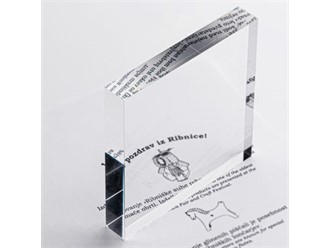
Polished acrylic edges: what to specify in your order
Which edges will be visible, which will meet other parts, and what finish do you need? A practical example for specifying polishing, chamfers and rounded corners.
Start by marking the visible edges
An acrylic shelf, cover or display component does not necessarily need the same finish on every edge. Label the edges A, B, C and D on your drawing and specify the finish for each one. Identify any edge that will be hidden, fitted into a profile or used for a joint.
High gloss, a matt finish or a different profile?
- Polished edge: for a high-gloss finish on clear acrylic (PMMA). Mark the edges that will be visible.
- Matt or satin edge: when you want a matt finish rather than high gloss.
- Chamfer: specify the angle and chamfer size, as well as the face of the sheet. State explicitly if both faces need this treatment.
- Rounding: distinguish a rounded corner in the outline of the sheet from a rounded edge profile across its thickness. Mark the location and required radius.
We agree the final appearance and machining method according to the material, thickness and part geometry. Polishing other plastics does not necessarily produce the same optical result as polishing clear PMMA.
An example of a clear specification
Clear PMMA, 5 mm thick, finished dimensions 600 × 300 mm, 2 pieces. Edges A, B and C polished; edge D intended for a joint. Two front corners rounded to R10 mm, marked on the drawing. No additional chamfers on the other edges.
This is an example of how to describe a part, not a thickness or design recommendation for your application. If the part must fit another component, include the required tolerance. Give all dimensions in millimetres.
What should you include in your enquiry?
Send a drawing with the edges marked, together with the material, thickness, finished dimensions and quantity. A reference photo can help explain the appearance you want, but it does not replace dimensions. Add the intended use and tell us whether you need delivery or collection.
